DZOFilm Vespid 2 vs Vespid vs Arles vs Arles Lustre
This article and video are sponsored by Artlist.
Get 2 Months Free of Artlist, Music SFX, AI & more.
Introduction
I want to know how the Vespid 2’s compare to the Vespids and Arles lenses. And for fun, we’ll throw in the Arles Lustres. My guess is that the Vespid 2’s will sit somewhere between the Vespid 1’s and Arles, but let’s test them out and see where they sit.
I tested out a set of Vespid 2’s a while ago, but I finally have the actual production versions now.
DZOfilm did loan me the Vespid 2’s to make this video, but all words are my own and they don’t get to see the video before it goes live.
Outdoor tests between all of the lenses
There are huge differences between these lenses, but were going to ignore all of those for a second and look at how these lenses look next to each other, straight out of the camera with only a color space transform. Here are some tests with the FX6, going through each lens, and aperture range. I did not move the camera while running through the different lenses, so the framing is a little strange on the wider lenses, but I wanted to show the differences in each lens in exactly the same spot.
There may be some exposure differences here, it was a really cloudy and windy day, but I did my best to time the clouds to get the most consistent light possible. Later in the video, I have the dark studio test in controlled lighting.
When I’m comparing lenses, I’m really interested in how the look wide open, and at what T-stop they sharpen up. Here is comparing all of the lenses wide open. Going to show each one on screen at once, then a side-by-side that you can pause to inspect them if you want. This isn’t a perfect test, as the light changes so much between tests - but I tried to time the light as consistently as I could.
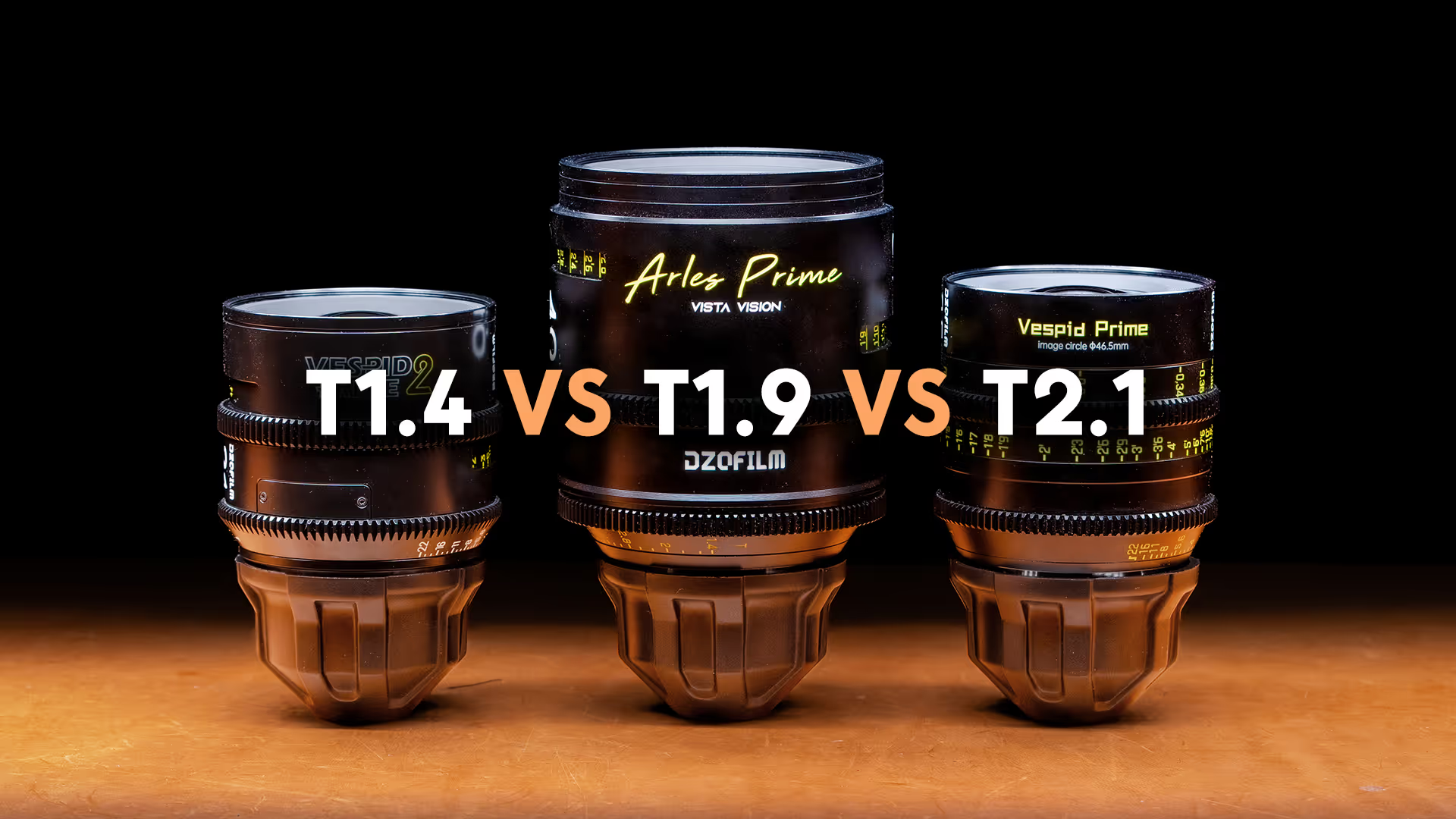
As a different test, I set up my Arles at T1.4, then wanted to compare it at T1.9 and T2.1, to simulate the differences between the lenses, but with the same framing and lighting. Is it worth the extra money to have a lens that can open up to T1.4 vs T1.9? Or T2.1? To me, T1.9 would work in most situations for me, wide open. But there is just something about the Arles wide open on a full frame camera that I really like.
Huge shoutout to my wife for dealing with me during these tests, because this took a few hours to do. Like and subscribe so I can continue to bribe her with coffee and sweet treats.
Price, Weight & Dimensions
Rent vs Buy
While were still going through the different looks, I just want to go over the price differences of these lenses too. The look is one thing, but the finances are also pretty important here.
Vespid 2 Price and Rental Rates
Vespid 2, 6-lens kit is $6,300. Since these lenses are so new, I have not been able to find any reliable sources for rental rates, but for example, let’s say they rent for $50 per lens. A 6-lens rental would be $300 per day, and you would pay them off in 21 days.
Vespid Price and Rental Rates
The Vespids come in a 5 or 7 lens kit, the 5-lens kit is 5800, on sale for $4,000. The Vespids rent for $50 per lens. 5-lens kit would rent for $250 per day, paid for in 16 shoot days if you get them on sale. 23 days if you pay full price.
Arles Price and Rental Rates
Arles 5-lens kit: $9800, somehow these also rent for $50 per lens, per day - so you would have to rent the entire set for 39 days to pay these lenses off.
Arles Lustre and Rental Rates
Arles Lutre 4-lens kit: $10,799, I was only able to find one on share grid for $175 in Atlanta, but in my market, I’d probably get closer to $100 per lens per day. So the 4-lens kit would take 27 days in my market, or 15.5 days if you were in Atlanta.
The Vespid 2’s come in at 21 days to pay off, right between the 16 days for the vespid 1’s and the 39 days for the Arles.
The Lustres are more specialized though, so I would probably rent the vespid 1, 2 or arles more often than the Arles Lustres. So the Lustres would take about the same time to pay off as the other lenses, I wouldn’t use them as much for their cool look and warm flares, so they would actually take longer time-wise to pay off.
Artlist Sponsor
Before we get into the build quality, I’d like to tell you about this video’s sponsor, Artlist.
Artlist has over 400,000 high-quality music, sound effects, footage, templates and more available to use in your personal or commercial work.
Artlist also have a suite of AI tools where you can create images, videos, and voiceovers.
For their image generation, you can use text to create an image. Or upload an image and describe how to transform your image.
For video generation, you can use text to video, or image to video, and select for a large range of different models. They have different versions of vero, sora and kling.
Artlist makes it simple to create high-quality images and videos.
I find myself using AI in preproduction to get my ideas across to clients quickly, but if you like to use AI to make your final deliverables, the Artlist license covers your AI images and videos for personal and commercial use.
I love Artlist for their music library, and their tools make it easy to find the song you need.
Their filters make it easy to choose a genre and refine your results with mood keywords. You can narrow down the music by which instruments are used, if you want vocals or not, or adjusting the BPM.
They also have tons of playlists to help give you some inspiration from different creators, moods or types of videos.
They also have a huge selection of Luts, footage and tools for your favorite editors speed up your edits.
Artlist has multiple plans, ranging from music and sound effects, AI suite, Footage and Templates, or everything with their Artlist Max plan - so you can choose which plan bests fits your needs.
Thank you, Artlist, for sponsoring this video and article.
Build Quality
When it comes to build quality and weight, here is a table of all the lens dimensions and weights. This took forever to make, so like and subscribe for this one. I also put minimum focus on this table, so spoiler alert, we’ll be seeing this again later.
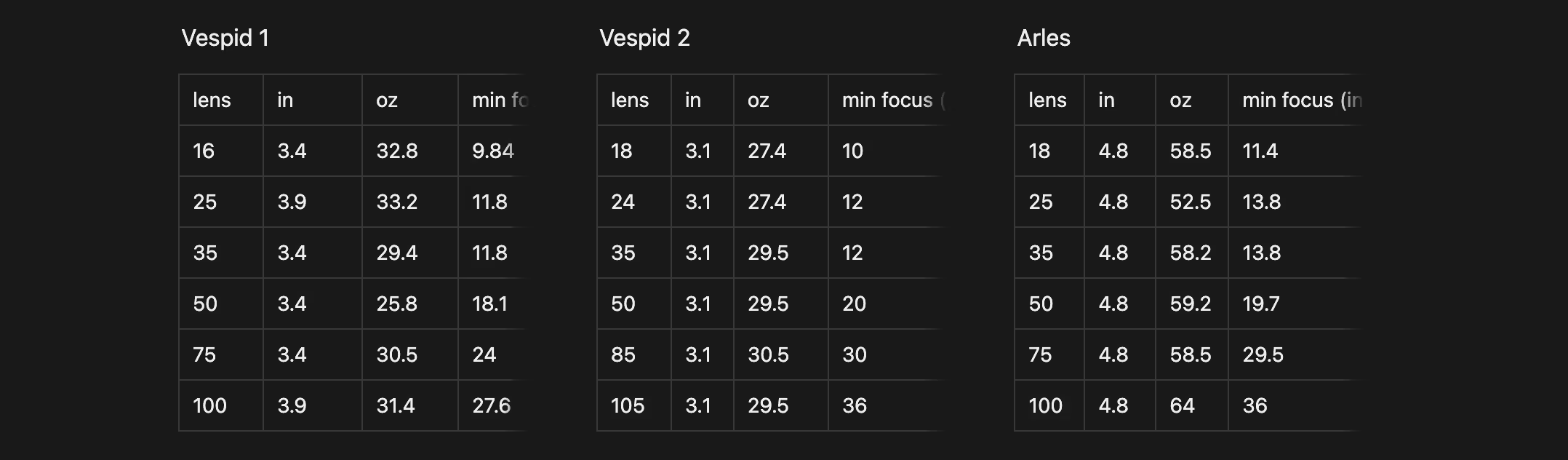
After lugging 5 to 7-lens kits of each of these lenses around, the Vespid 2’s are the easiest to take around with me. My arbitrary rating for the portibility of the V2’s is 8.8/10. For a 6-lens kit, it’s not a problem at all to take around.
The Vespid 1’s are a little heavier and larger per lens, and the case is larger, so it all adds up to a bigger footprint and more weight. I give them a 7.5/10 for portability. Still can do it, but the larger case and heavier lenses make it a little more difficult to travel with.
The Arles 5-lens kit gets a 5.9/10 on the portability scale though. Which surprisingly isn’t THAT bad, but picking up a 5-lens set of Arles, after picking up the 6-lens set of Vespid 2’s is a huge difference.
Flare
When it comes to flaring, just to get the specialized lens out of the way, the Arles lustre is skews cold, but the flares are really warm. And it is very easy to flare this lens, I accidentally flared this lens when using it in the low light indoor shot. The amaran f22c was kind of almost hitting the lens for all of the lens tests, but it causes the lustre to flare. I love this lens, it’s really easy to see those flares.
Onto the more common lenses here, the Vespid 1’s have the warmest, and most apparent flares, ignoring the Arles lustre which is just in a league of it’s own. The vespid flares warm, and is pretty easy to see the flares.
The Vespid 2’s are surprisingly well controlled and skew a little cooler. They remind me of the Arles, more than the Vespid 1’s.
The Arles have a very well controlled flare, and when the do flare, they tend to be cooler blue flares. These lenses have a very nice coating on them to control the flaring, and if I’m using a hard backlight that I don’t want to wash out the image, I’ll use the Arles with a mattebox to keep the most contrast, but if you need a smaller setup, the Vespid 2’s would handle this well too. The Vespid 1’s would have a pretty stylized look if thats what you’re going for. Or if you want insane flares, the lustres are next level.
Chromatic Aberration 1 vs 2 vs Arles
When it comes to chromatic aberration, the Vespid 1’s have some ca, but cleans up when you stop down around 4 or 5.6. The Vespid 2’s I havent really noticed any distracting CA, but if you’re looking for it they clean up around T2.8 surprisingly.
The Arles control CA pretty well, and I don’t notice much CA at all with them. If I’m really looking I can see some wide open on the edges, but around T2, I don’t notice much.
Bokeh
18: Bokeh cleans up on edges by T5.6
24: Bokeh cleans up on edges by T4
35: T2.8
50: T4
85: T2.8 to 4
105: T4, can see a little hexagon pattern, not perfectly circular. At T8 to 11, the bokeh is circular
Lens Characteristics: Sharpness & Color Casts
When it comes to talking about the look of each of these lenses, I think it makes sense to talk about sharpness and color in the same section, so for the sharpness tests, I shot the sharpness chart for each lens.
For color cast, I shot my color checker passport on my white table, with no other reflections or colors around it.
The Vespid feels a little soft wide open, the center is sharp, but edges of the frame are a little soft until around T2.8 or even 4 if you’re really pixel peeping. For the Vespid colors, this lens feels pretty neutral overall, maybe a little warm.
I’m surprised at how sharp the Vespid 2’s are when comparing them to the 1’s. The Vespid 2’s are sharp in the center wide open, and the edges sharpen up around T2.8. It took the Vespid 1’s until T4 or even 5.6 to sharpen up, while the 2’s are sharp by T2.8. This was one of the more surprising results of these tests for me. This also translates to less distortion, when comparing them to each other at the same focal lengths too.
The Vespid 2 is a little bit warmer than the vespid 1’s. It’s about as warm as the Arles, and a bit warmer than the Vespid 1’s. If you happened to catch my original video, then this is one of the big differences between those pre production lenses and these final production lenses. The pre production ones were pretty warm. These lenses arent as warm and remind me of the Arles lenses.
The Arles is a little warm but I don’t mind it. It’s not overpowering. I think the Vespid 2’s have more in common color-wise with the Arles than the Vespid 1’s. The Arles is sharp in the center, and takes the about T2.8 to sharpen up on the edges, or sometimes until T4, like on the 50mm. But in general, the edges clean up pretty well by T2.8.
The Arles Lustre is the wild card here. This lens skews really cold, while the flares are really warm. It’s a very specialized lens, but to save you guys from looking at charts on this one, it’s sharp in the center, but takes until T4 or T5.6 to sharpen up the edges.
Minimum Focusing Distance
When it comes to minimum focus, here is a chart showing minimum focus in inches. All of these lenses are usable when you’re shooting with them, and none of them feel too far away.
The Vespid 1’s have impressive minimum focus, the Vespid 2, again, sits right between the Vespid and Arles, and if I had to be picky, the outliers to me are the 75 and 100mm Arles. I’ve spoiled and use my macro lenses for product shots, and I would love to have the image quality of the Arles, but use them closer up for product shoots, but at that point, I’ve been using dedicated macro lenses. Would love to see the Arles and Vespid 2 have a 100mm macro introduced to the line up.
Focus Breathing
When it comes to focus breathing, all three of these lenses do a pretty good job at controlling the breathing. The Vespid 1’s has slight focus breathing, the Vespid 2’s have more focus breathing, but not too much that anyone would really notice unless you’re doing huge focus racks. These tests are going from minimum to infinity, and this is the worst it would ever be. For smaller focus racks, I did not find them distracting.
The Arles are well controlled, and wide open it almost looks like there is some focus breathing, but I think part of it is because at T1.4 everything is so blurred out that it looks like there is more focus breathing than there actually is. I’m able to see some, but you have to really be looking for it. I think all of these lenses handle breathing well.
Simera-C’s vs Vespid 2’s
For the simera-c’s vs the vespid 2’s, those lenses have a few differences that kind of warrants it’s own video. Let me know if you’d like to see that and I’ll make a specific simera-c vs Vespid 2 video.
Which Lenses to Choose & Lens Combinations
When it comes to lens combinations, this is there things can get interesting. Hot take here, and I swear DZO did not tell me to say this, but all of theses lenses are different enough, where I could see owning multiple sets of these lenses. These range from affordable to more expensive, and from clean to a very stylized look.
I think if you want an affordable, clean lens set, the Vespid 2’s are the choice to make. If you want faster, clean lenses, then go with the Arles.
If you want an affordable, creative lens set, go with the Simera-c’s, or Vespid 1’s. Or if you want faster, creative lenses, the Arles Lustres are the choice.
Or if you want a small, clean and creative set, the Vespid 2’s and simera-c’s would be a fantastic set.
It really comes down to what your project needs are. It’s a great time to be in the market for a set of lenses. The tough part is going to be which lenses you’re going to choose.