Sony 50-150 GM vs 70-200 GM II- Battle of the Expensive Zooms for Video

70% off your first year of Audiio Pro with code KEITH70
The Sony 70-200 GM II has been my go-to telephoto lens. But as soon as the 50-150 came out, I was interested in how these two lenses stacked up against each other for video.
I was able to find portrait photographers comparing these two lenses, but not many video-first reviews. So I decided to rent them and test them out myself.
To setup what I use these lenses for, I’m using them for a B-camera angle for talking heads, and general b-roll for interviews or documentary-style shoots. Thats the lens that I’m looking through at these, lenses.
Price Differences
When it comes to price, both of these lenses are expensive, and there is also a big difference between them.
The Sony 50-150 costs $4,000, while the Sony 70-200 GM II costs $3,200.

Can the 50-150 Replace Prime Lenses?
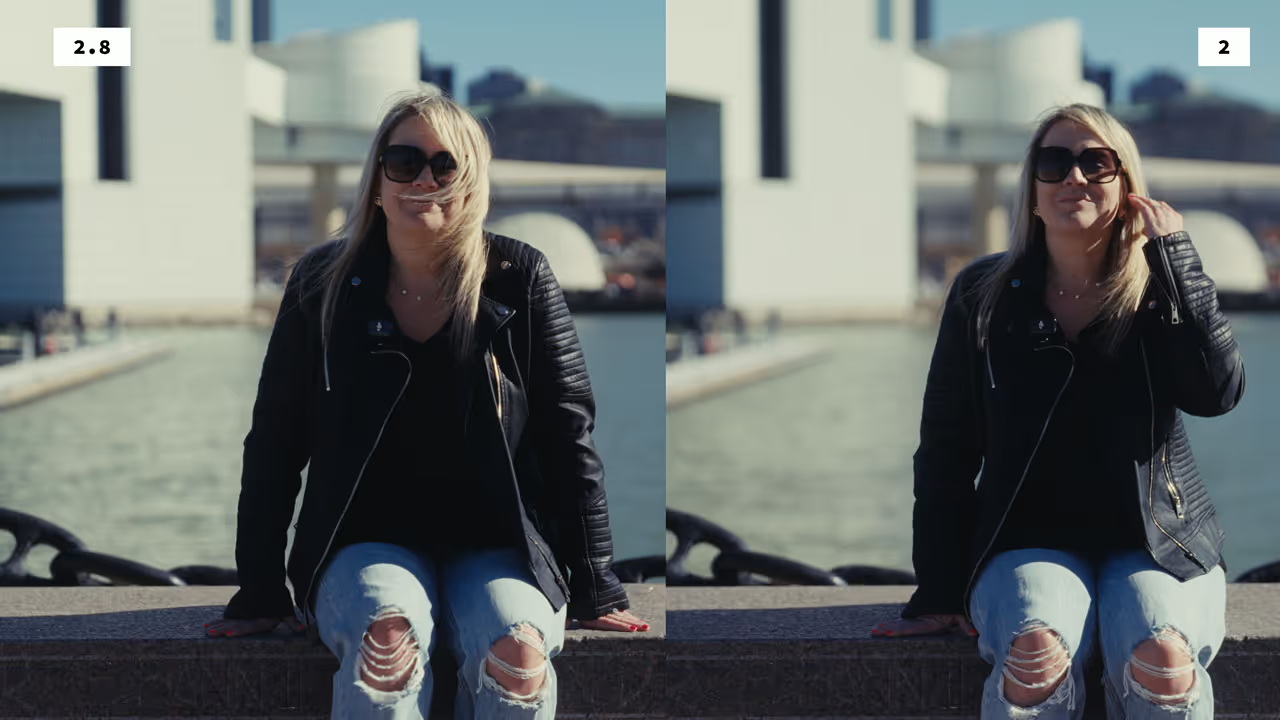
Here are a few aperture differences. These are using the Sony 50mm f/1.2 at different apertures to see if the 50-150 can replace a bag full of primes. This is ignoring the obvious reality of needing to switch lenses, and only focusing on the look of each different aperture.






Sponsor: Audiio
I want to thank this article and videos sponsor, Audiio.
Audiio offers a fantastic catalog of music, stems, sound effects, voices, and search tools - at a great price.
There are thousands of tracks, and sound effects to choose from, and they have search tools to help you find what you need.
LinkMatch allows you to paste a link from youtube or spotify, and their tools will analyze the song, then recommend similar songs that you can license and use in your projects.
If you want to describe what you’re looking for, you can tell Hans, and they will give you a list of music to choose from.
I love these tools because it speeds up discovery and I can quickly find the music that would fit my video.
Thank you Audiio for sponsoring this video.
Focal length comparison
Aperture is only a part of the equation, the difference in focal length is almost more interesting after I was using these lenses.
50 vs 70



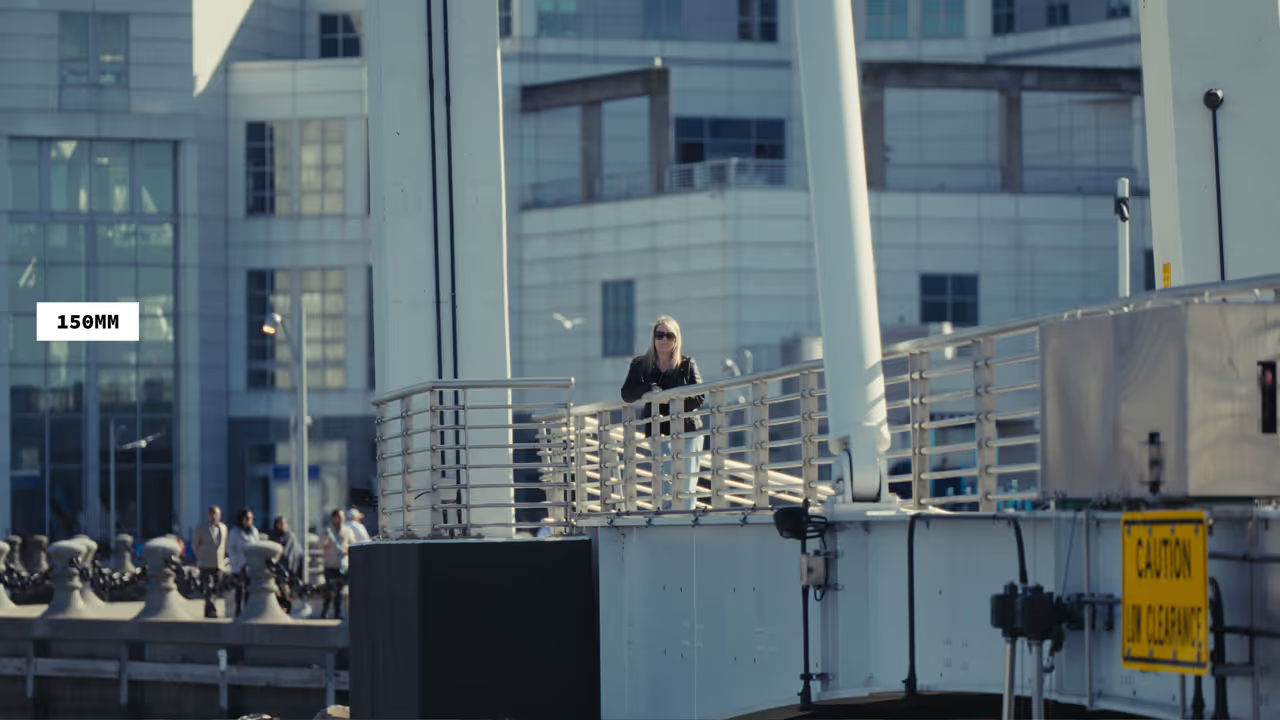
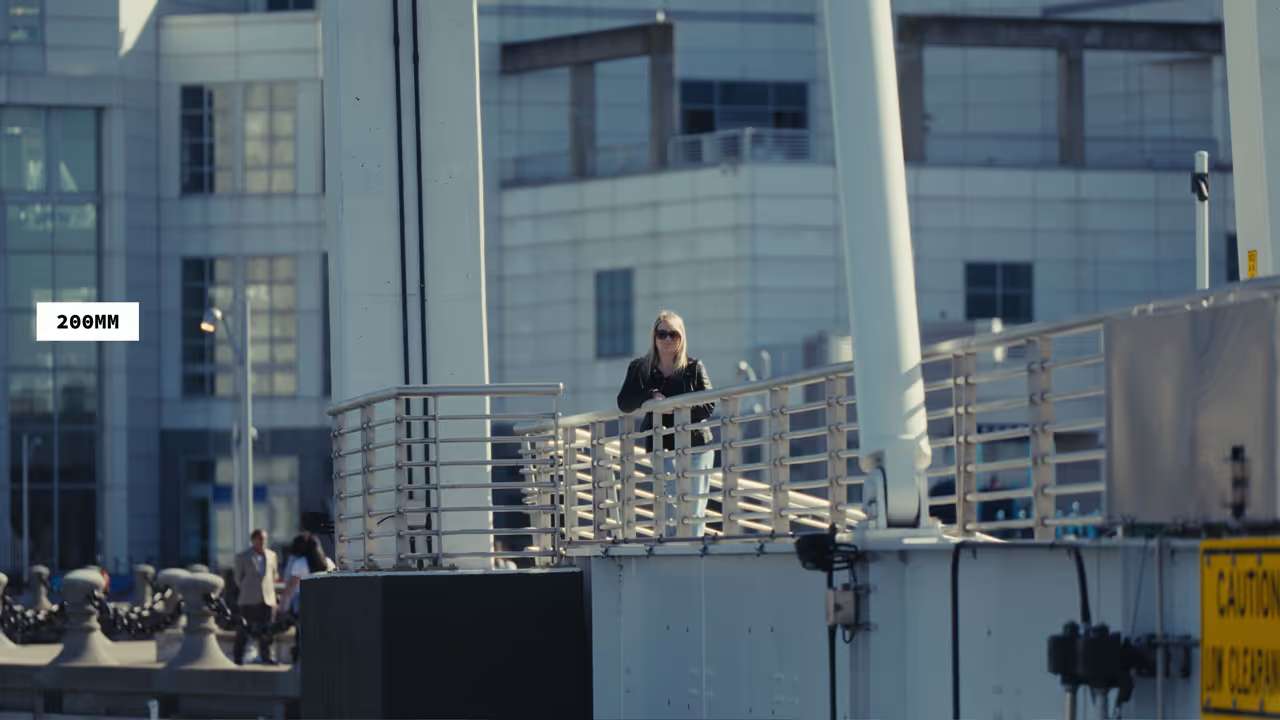
150 vs 200
On the telephoto end of these lenses, this is less important, to me at least, because I rarely find myself shooting over 125 or 135 anyways. But I wanted to test this out still. Here is the difference between 150 and 200, keeping the camera in the same position.
Stabilization vs No Stabilization
One part of this video that surprised me was stabilization. There is no lens stabilization on the Sony 50-150, even though it’s $800 more. That was a strange choice. Maybe because the 50-150 is closer to the general 24-70-type length, so you can rely on just in camera stabilization? But the 24-105 has optical stabilization, so this was a little puzzling to me. The 50-150 is already a chunky tank, why not add more weight, and include stabilization?
I don’t know, but if you’re hand holding your camera shooting sports, there will be a noticable difference with stabilization on and off at 150mm. Less obvious at 50, but the more telephoto the more noticable shake. That might steer some people away from the 50-150 based on stabilization alone, keep in mind the FX6 doesn’t have any active stabilization.
Could be a pro or a con depending on how you like to shoot.
Similarities
- Autofocus is great, 4 XD linear motors
- 11 aperture blades
- Internal zooming
- Tripod collars are removable
- Clicked or de-clicked aperture rings
Sharpness comparison between the lenses
When it comes to sharpness between these two lenses, this is going to be a quick section.
I did some tests and couldn’t tell a meaningful difference in video footage. In photos, and zooming in 300%, you might be able to tell a difference, but thats not my use case for these. I think both are extremely sharp, even wide open.
Minimum focus differences
Here are the minimum focus for each of these lenses:
Sony 50-150: Wide: 1.3' / 40 cm. Telephoto: 2.4' / 74 cm
Sony 70-200 GM II: 15.7" / 40 cm
Teleconverter on GM II vs f/2
For using a teleconverter, 70-200 can use the teleconverter, 50-150 cannot. If doubling your lens length with the 2x convertor is helpful to you, the 50-150 is already out. I don’t use teleconverters, but wanted to include this in case you do.
Differences

Filter differences
Filter size differences are huge with these two lenses. The 50-150 has a 95mm course front filter, while the 70-200 has a 77mm filter.
Size and weight differences
For size and weight differences, the biggest difference is the 50-150 is a little over a half pound heavier and a half inch wider in diameter. On paper, that doesnt seem like much, but if you’re using these lenses side-by-side there is a big difference between each of these lenses. But when looking at the original Sony 70-200, I found something interesting.
The original sony 70-200 was 3.3 lbs and 3.5in, so if you were used to the 70-200 GM I, then the 50-150 is a half inch larger in diameter, but it's .4 lb lighter!
Sony 50-150: 2.9 lb / 1340 g | 4 x L: 7.9”
Sony 70-200 GM II 2.3 lb / 1045 g | 3.46 x L: 7.87 in
Conclusion - Which Would I Buy?
When it comes to the Sony 50-150 vs the Sony 70-200 GM II for video, both of these lenses are fantastic. It’s almost easier to choose between different cinema lenses, because you can choose a set based on their look.
At the same aperture and focal length, both of these lenses look the same to me. They both have all the features I want, like the aperture ring and internal zooming.
Stabilization is a bit of a bummer, I wish the 50-150 had the option for stabilization, there are times when I’m filming past 100mm on the FX6 handheld and it’s tough to keep the camera stable for long takes. At that point, I should probably just keep the camera on a tripod, but this is still tough for docu-style shoots when you need to capture images quickly. The FX6 does not have internal stabilization, and the 50-150 does not have any internal stabilization either. I noticed a difference at the tighter focal lengths, 135mm and above, that it was tough to keep things steady for long takes.
This really does come down to how you use the lenses.
For me, I use autofocus lenses mostly for smaller jobs, or if I’m filming people when I have more cameras than camera operators. I have to be able to rely on the autofocus.
In my use-case, the 50-150 is a better choice for me because this lens can be both my a or b camera lens on a documentary-style interview. It covers my telephoto that I typically shoot at, 70-135 - but it also can be a "medium shot" lens at 50mm as well. And at f/2, I can get away with using this lens instead of primes for talking heads. I rarely find myself shooting B-cam at shallower than f/2 or even f/2.8 because I like to have both eyes in focus and the b-cam angle is typically more at an angle than the a-cam.
The 50-150 is larger, costs more, and has more annoying filters to work with, but for me, I would justuse this lens more.
Where this lens would be really helpful, is if there is only budget or were moving so fast, we only have one camera and one lens, I could shoot an interview at 50 for the “a-camera” look, then while the interviewer is asking another question, move the camera to where a b-camera angle would be, punch in to 70 or 85, and then have a b-camera angle too.
I havent found myself shooting above 135mm in the past year in what I’m shooting. So the telephoto end of these lenses isn’t as compelling as the wider end. And at 150mm, I can also use clear image zoom if I need to.
If you’re filming mostly on the telephoto end, the Sony 70-200 GM II is the clear winner, it's smaller, lighter, $800 less, and the stabilization will help out a lot - but the focal range and speed of the Sony 50-150 is worth the extra $800 for me. Especially since I'll be using it on client gigs where I can charge a rental rate to cover the difference.
Let me know what lens you guys would choose and why in the comments on YouTube!